
Disclosure: As an Amazon Associate I earn from qualifying purchases. Shopping links in this guide are paid links.
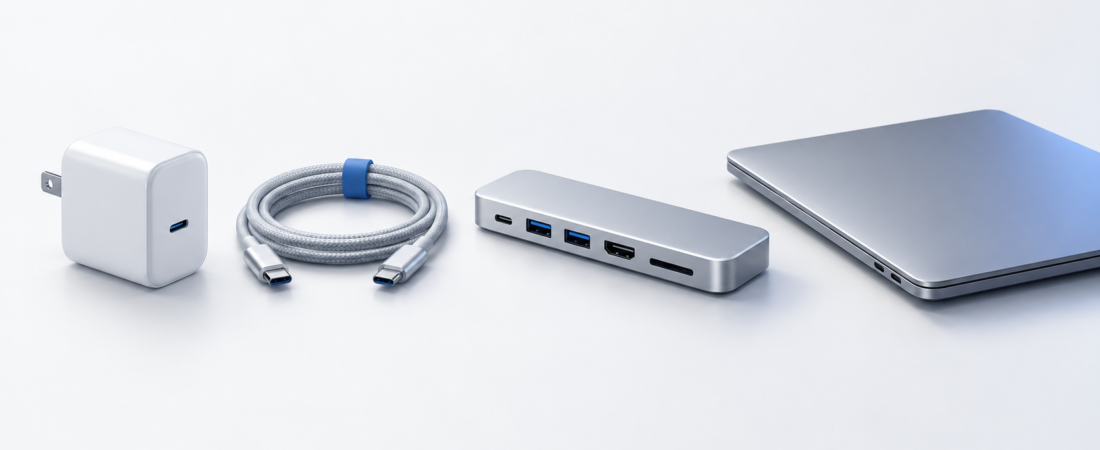
Research-based guide: No hands-on testing. Cover image is an AI-generated conceptual illustration, not a photograph of the named products or evidence of testing.
A “100W” hub is not necessarily a 100W laptop charger. The label may describe the power the hub can accept, while its stated laptop output is lower. Read both figures before deciding whether pass-through charging will suit your computer. A hub also does not replace the wall charger unless one is explicitly included.
Keep four different power figures separate
| Figure | What to look for | Buying question |
|---|---|---|
| Charger output | Output available from the port you will use | Does connecting another device change that allocation? |
| Hub input | Maximum USB-C PD input rating | Does the hub accept the intended charger configuration? |
| Output to the laptop | A separate host-output or laptop-output rating | Does the maker explicitly state it? |
| Actual draw | What the connected system requests and uses | Am I confusing a maximum rating with a constant charge rate? |
USB Power Delivery is designed to coordinate power between connected devices. A maximum capability is not an instruction to push that power continuously into a battery. The USB-IF Power Delivery overview describes flexible power management; the specific charger, cable, hub, and computer still determine your setup.
A concrete example: 100W in, up to 85W out
Anker lists 100W PD input and 85W maximum laptop output for both its 332 (A8355) and 555 (A8383). Those figures illustrate why the input label alone is insufficient. They do not establish a universal rule that every hub subtracts 15W. Sources: Anker 332 specifications and Anker 555 specifications.
The practical comparison is therefore not simply “100W hub versus 65W charger.” Ask what your computer requires for the intended work, what the charger can supply on that particular port, and what the hub documents at its host connection. Where a specification is missing, ask the manufacturer rather than estimating an exact output.
Three common situations
- You already have a laptop charger: keep it in the comparison. Check its output label and the hub’s requirements before assuming you need to replace it.
- You share a multiport charger: inspect the charger’s allocation table for the combination of connected devices you actually use. The large number on the charger may describe its total capacity.
- You want a one-cable desk: include the upstream cable and charger in your plan. A convenient cable arrangement is not proof of faster charging.
Avoid the wrong USB-C socket
A hub can have one USB-C socket labeled PD input and another labeled data. The identical connector shape does not make their roles interchangeable. Follow the hub’s port labels and manual: connect the charger to the specified power input, and keep peripherals on the documented data ports. Do not assume a data socket can drive a monitor either.
A pre-purchase power worksheet
- Computer model and manufacturer’s charging guidance: __.
- Charger model, selected port, and output with other devices attached: __.
- Cable power rating and compatibility: __.
- Hub’s published input limit: __; published output to laptop: __.
- Included charger or cable, and any additional cost: __.
If you cannot fill in the host-output line, the purchase is not ready. If you can charge the laptop directly through a separate supported connection, compare that arrangement with hub pass-through instead of treating one cable as an absolute requirement.
What this guide cannot tell you
We have not measured charging times, electrical efficiency, temperature, or battery behavior. An 85W maximum does not promise that a laptop will draw 85W, maintain its battery under every workload, or achieve a particular fast-charge time. Those require model-specific guidance and, for measured outcomes, testing.
Check the exact model on Amazon
Affiliate disclosure: We may earn a commission if you buy through the product-name links or Amazon buttons below. Confirm the selected model, seller, condition, price, and return terms on Amazon before ordering.
Anker 332 USB-C Hub (A8355): compare the input and host-output specifications, not just the headline wattage.
Anker 555 USB-C Hub (A8383): its additional connections do not change the stated 85W maximum host output.
Continue your research
Sources and method
Prepared from the manufacturer and standards documentation linked below, checked September 16, 2026. Product specifications are advertised limits, not results from our own testing. We have not handled or bench-tested these products. Our recommendations are conditional buying judgments, not performance rankings.